Soft-Touch Lamination: Premium Feel, Fingerprints, and Scuffing
TLDR
Soft touch laminate scuffing is not always a sign that lamination failed. A soft-touch film is selected primarily for its muted appearance and tactile feel; it is not automatically immune to scratches, burnishing, fingerprints, or abrasion. Identify the type of mark first, then review the film grade, print-system compatibility, full finishing sequence, packing method, and expected handling. For demanding jobs, specify a purpose-built scuff-resistant film and approve a production-representative test rather than relying on a generic soft-touch sample.
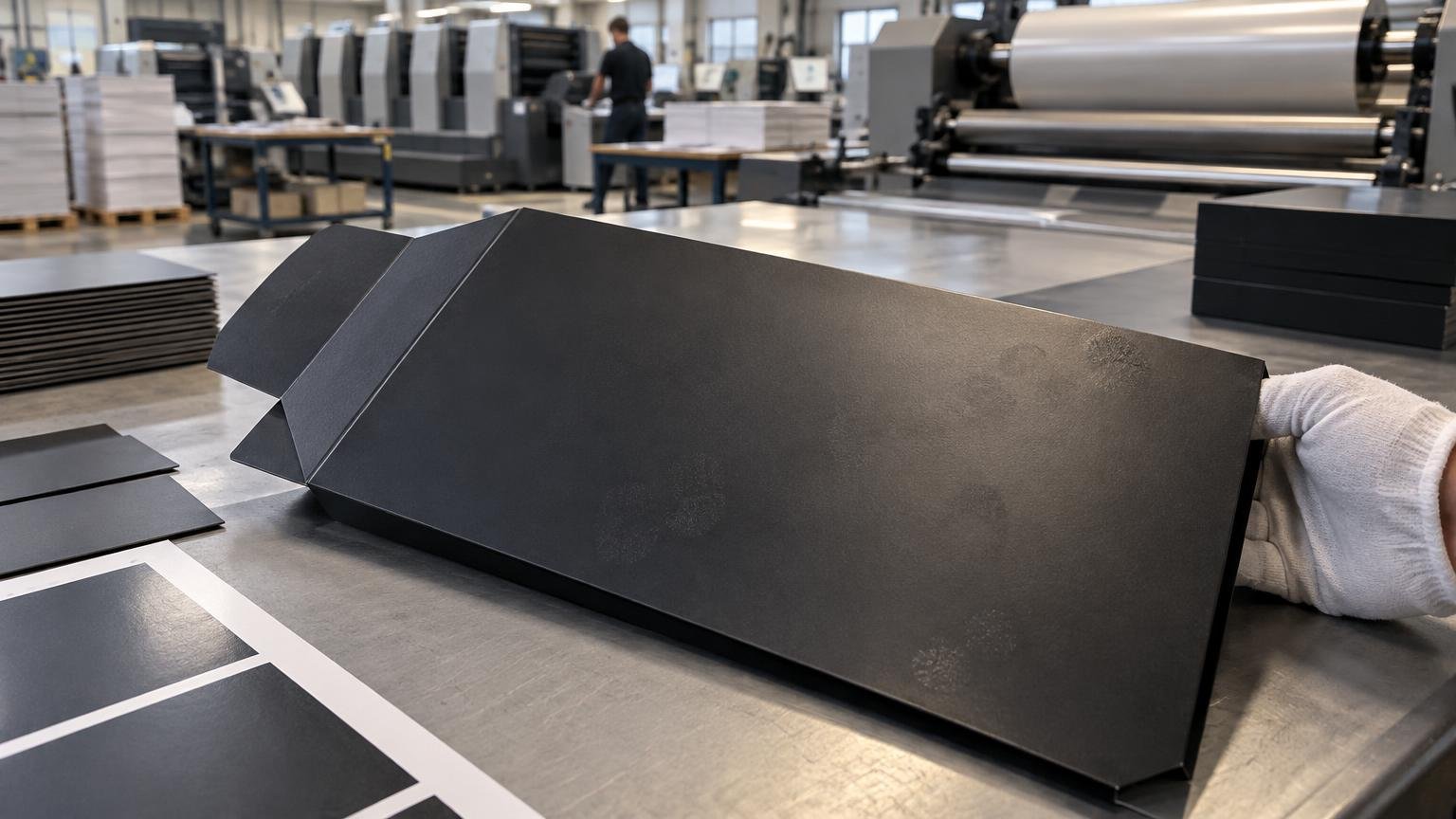
The practical problem is that several defects can look like soft touch laminate scuffing from a distance. A gray streak on a black presentation folder may be transferred material, a polished area caused by rubbing, or a scratch in the surface. Cracking beside a score or film lifting from the sheet points toward a different production issue. The correct remedy depends on which failure is actually present.
Start by identifying what kind of mark you have
Use strong, angled light to inspect the piece, but do not begin by rubbing or cleaning it. Compare an affected piece with an untouched sample from the same run. Note whether the mark changes with viewing angle, follows a consistent contact point, appears beside a fold, or can be traced to stacking and packing.
| Visible symptom | Possible explanation | What to investigate |
|---|---|---|
| Gray or whitish rub mark | Transferred dust, paper fibers, packaging material, or a surface abrasion | Check neighboring pieces, cartons, interleaving, straps, and repeated contact points. |
| Area that looks shinier than the surrounding finish | Burnishing, where contact has changed the appearance of the low-gloss surface | Review stacking pressure, feeding surfaces, packing density, and high-touch areas. |
| Narrow line or groove | A scratch caused by a hard particle, rough edge, guide, or downstream tool | Inspect cutters, tables, conveyors, dies, packing areas, and debris control. |
| Fingerprint-shaped change in sheen | Skin oils or residue altering how light reflects from the surface | Evaluate normal handling under representative lighting and decide what appearance is acceptable. |
| Bubbles, lifting, silvering, or broad separation | A possible bonding, pressure, temperature, compatibility, or process problem | Escalate to the printer or laminator with retained samples and complete job details. |
| Cracking or lifting at a score, fold, or die-cut edge | Stress from converting or an unsuitable production sequence | Test scoring, folding, cutting, and other finishing on the actual laminated construction. |
These are diagnostic starting points, not remote proof of a root cause. Film, adhesive, substrate, ink or toner, lamination conditions, curing, finishing, storage, and transit can all influence the result. Preserve several affected and unaffected pieces, along with their packaging, before asking the printer to investigate. If the issue appeared after delivery, the documentation workflow used for damaged or incorrect print shipments can help separate production defects from transit damage.
Why dark soft-touch print shows marks so clearly
Black, navy, charcoal, and other dark solids tend to make changes in sheen or surface texture more visible. A polished patch reflects light differently from the surrounding matte area, while light-colored transferred material creates strong contrast. The mark may therefore look severe even when the physical surface change is small.
Large solid areas also leave nowhere for a mark to hide. Detailed artwork, photography, and lighter backgrounds can visually mask minor handling changes that stand out immediately on a plain black box or folder. This does not mean dark artwork is unsuitable for soft touch. It means the appearance standard, handling route, and protective packing deserve more attention during specification.
Fingerprints introduce another variable. The visibility of skin oils depends on the film, lighting, color beneath it, and how the piece is handled. A sample viewed flat under office lighting may look acceptable, while the same surface can reveal prints under directional retail lighting. Approval should therefore reproduce the way the finished item will be presented and touched.
Soft touch and anti-scuff are not interchangeable specifications
“Soft touch” describes a tactile and visual target. “Anti-scuff” or “scuff-resistant” describes a durability property. One film can offer both, but the terms do not automatically mean the same thing.
For example, Celloglas describes Cellotouch as a matte BOPP soft-touch film with a tactile surface and anti-scuff properties. That supports the point that anti-scuff performance can be incorporated into a soft-touch product, but it should not be generalized to every film sold under the soft-touch or velvet label.
Durability also exists on a spectrum. Dunmore presents soft-touch durability and scuff resistance as properties that can be engineered for an application. The supplier reports no visual surface change after 250 rub cycles in an ASTM D5264 test of its Dura Soft Touch Film, but that is a product-specific supplier result, not a universal benchmark for soft-touch lamination.
The buying question is therefore not simply, “Does this job have soft touch?” Ask which named film grade will be used, what abrasion claim applies to it, and whether that claim was evaluated on a construction comparable to your printed piece. A film-only result does not account for your ink coverage, substrate, adhesive bond, scores, folds, die cuts, embellishments, packing, or shipment.
Build a complete lamination specification
A reliable specification connects the desired feel to the production system and the life of the piece. Include the following information when requesting a quote or production sample:
- Finished size, flat size, page or panel arrangement, and quantity.
- Substrate type, weight or thickness, surface treatment, and recycled-content requirement if relevant.
- Print process, press type, ink or toner system, and whether the piece has heavy or full-bleed coverage.
- The exact soft-touch film or coating grade, not only the words “velvet” or “soft touch.”
- Lamination method and whether the film and adhesive are approved for the selected print process.
- One-sided or two-sided lamination, along with any tendency for the construction to curl.
- Downstream operations such as scoring, folding, die cutting, digital cutting, foil, embossing, gluing, or spot coating.
- Expected handling, including retail display, sales-kit use, repeated opening, mailing, fulfillment, or long-term storage.
- Pack-out details such as interleaving, orientation, carton count, shrink wrapping, straps, and pallet configuration.
- A visual acceptance standard that defines the lighting, viewing distance, sample area, and allowable marks.
Finishing can materially change both cost and risk. Laminate may affect cutting, folding, feeding, foil adhesion, gluing, and packing, while extra tests and protective materials add labor and waste. These operations should be visible in the estimate rather than treated as an unspecified premium finish; the same principle applies when reviewing materials, setup, waste, finishing, and freight in a print estimate.
Confirm compatibility with the print process
Do not assume a film that performs well over offset ink will behave identically over toner or UV inkjet output. The complete combination of print surface, adhesive, pressure, temperature, speed, and post-print condition matters. This is one reason the choice between offset and digital printing should be settled before the finishing specification is finalized.
Nobelus, for example, markets a ScuffProof laminate version specifically for UV inkjet and electrophotographic output, including applications involving toner and fuser oils. That is a product-specific capability, but it illustrates the type of compatibility statement a buyer should request for digitally printed work.
Give the laminator the press and consumable details when possible, especially for a new construction. If the production route might change after quoting, require approval before substituting a press, substrate, film, or adhesive. A visually similar replacement may not have the same bond or abrasion behavior.
Test every operation that touches the laminated surface
A pristine laminated press sheet proves little about a folder that must later be scored, folded, foil stamped, die cut, stacked, boxed, shipped, unpacked, and handled repeatedly. Run the production-representative sample through the intended finishing sequence. Conventional and digital cutting introduce different handling and setup paths, as explained in the comparison of die cutting and digital cutting.
Inspect pieces immediately after each stage. This narrows the point at which marks begin to appear. If sheets are clean after lamination but marked after cutting, the investigation can focus on cutting, delivery, stacking, and debris. If marks appear only after transit, carton movement, packing pressure, or contact between finished pieces becomes more relevant.
Use rub testing as a comparison, not a magic pass number
The ASTM D5264 practice for abrasion resistance covers comparative evaluation of printed materials with a Sutherland Rub Tester and can be applied to inks, coatings, laminates, and substrates. ASTM also notes that abrasion damage can occur during shipment, storage, handling, and end use, and that time, temperature, and humidity can affect results.
That makes controlled rub testing useful for comparing candidate constructions, diagnosing changes, and establishing a repeatable approval method. It does not create one universal cycle count that makes every soft-touch job acceptable. The appropriate load, cycle count, contact material, environmental conditioning, inspection lighting, and failure definition must reflect the application.
For example, a short-run invitation handled a few times has a different risk profile from a black folding carton moving through automated packing and retail distribution. A sales presentation folder may need to withstand repeated insertion into bags and briefcases. The same laboratory result does not carry the same practical meaning for all three products.
Ask the printer to test the finished construction whenever feasible. That means the actual stock, printed coverage, adhesive, film, lamination conditions, and representative curing or conditioning time. Add a packed transit trial when carton contact and shipment are major risks. Keep approved control samples so that the production run can be compared with something more precise than a description such as “premium matte.”
A prevention workflow for future runs
- Define the end use. Record how often the piece will be touched, where it will be displayed, and whether appearance must remain pristine throughout distribution.
- Identify the print system and substrate before choosing the film. Confirm adhesive and film compatibility with the actual ink, toner, fuser-oil, or UV-inkjet workflow.
- Shortlist named film grades. If abrasion is a central risk, compare purpose-built scuff-resistant soft-touch options rather than accepting an unspecified standard film.
- Produce a representative sample with dark coverage, folds, cut edges, foil, spot coatings, or other difficult features included.
- Run the complete finishing sequence. Inspect and photograph samples after lamination, cutting, folding, embellishment, packing, and transit simulation.
- Agree on a test and visual standard. Define viewing conditions, permitted marks, rub-test settings if used, and who has approval authority.
- Review pack-out. Eliminate unnecessary face-to-face movement, hard debris, rough interleaving, excessive pressure, and loose contents where practical.
- Lock the approved construction. Record the substrate, print process, consumables, film, adhesive, finishing route, test method, packing, and approved sample.
This workflow may increase sampling and setup costs, but it is usually more economical than discovering an appearance mismatch after an entire run has been converted and shipped. For a high-visibility launch, begin with a controlled quantity before committing all versions or destinations. A commercial print provider such as Printiverse can be approached with the artwork, production method, intended use, finishing sequence, and handling requirements already documented.
Can scuffs be removed from soft-touch lamination?
Do not promise restoration. If the mark is loose transferred material, a printer may be able to evaluate a safe removal method on a sacrificial sample. If rubbing has polished, scratched, or otherwise changed the low-gloss surface, additional rubbing or cleaning can enlarge the shiny area or create a new mark. Solvents and household cleaners can also affect the film, printed edge, adhesive, or nearby embellishments.
Set aside several samples and ask the printer or film supplier to evaluate them before attempting treatment on usable pieces. Record any method they approve and test it away from important artwork. If the surface itself has changed, replacement or acceptance under an agreed tolerance may be more realistic than repair.
Specify durability as part of the finished product
Soft touch is valuable because it changes how a printed piece looks and feels, but tactile appeal and abrasion resistance are separate requirements. When scuffing would undermine a dark carton, folder, cover, or card, specify a named film with suitable durability and print-process compatibility. Then test the full construction through finishing, packing, shipment, and representative handling.
The next step is to send the printer more than an artwork file. Provide the intended print process, substrate, coverage, finishing sequence, pack-out, shipping route, handling expectations, and examples of unacceptable marks. That turns “make it feel premium” into a production specification that can be sampled, tested, priced, and approved.