Vinyl, Mesh, and Fabric Banners: Choosing for Wind, Finish, and Reuse
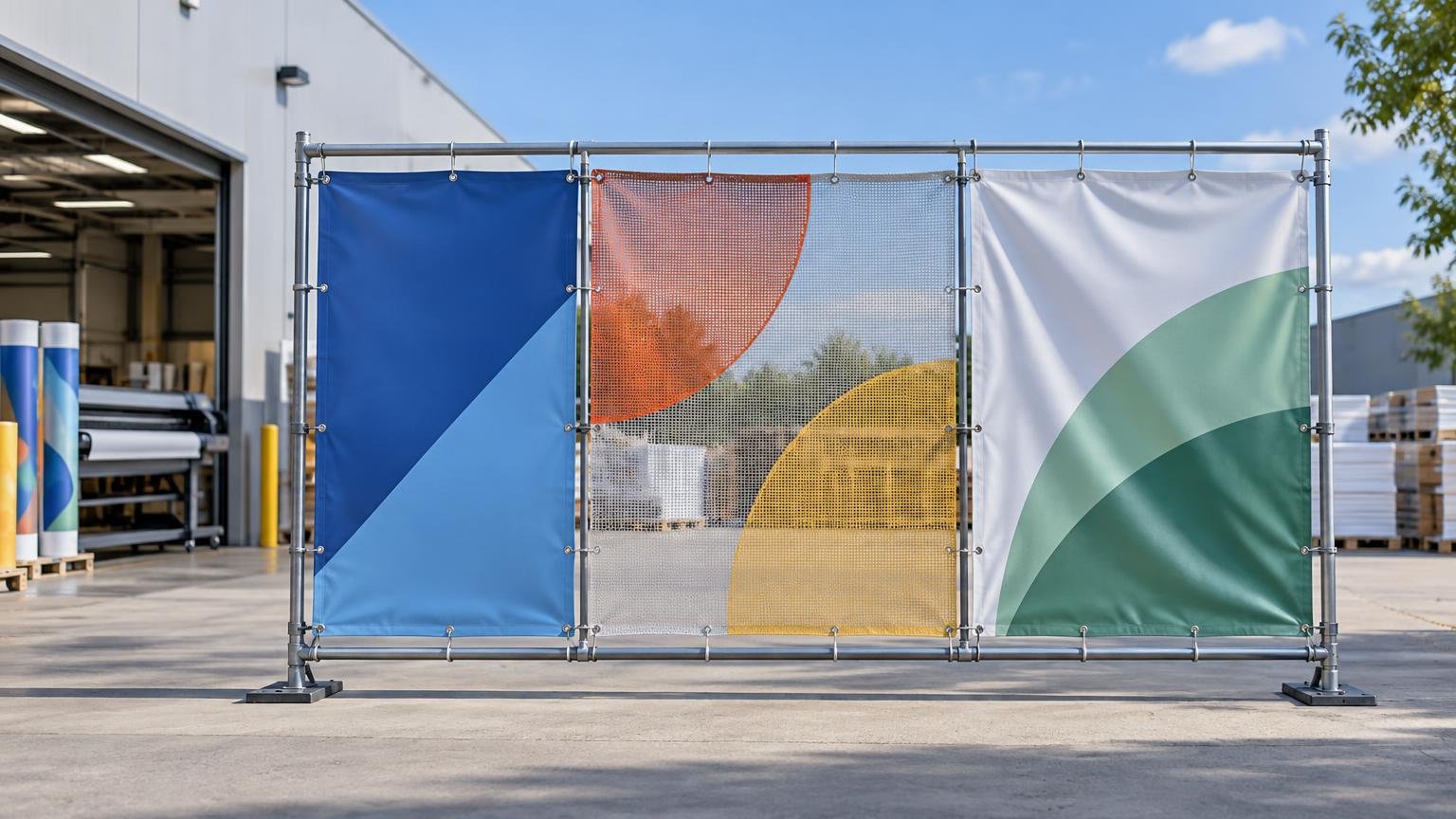
TLDR: For the banner material vinyl mesh fabric decision, choose solid vinyl when image density, opacity, and close-range readability matter most; choose mesh for exposed outdoor locations where airflow is important; and choose fabric for a softer presentation, controlled indoor display, or a reusable graphic system. Mesh can reduce the surface area presented to wind, but it does not make an installation automatically safe. Final material, finishing, and attachment decisions must account for the complete installation.
The practical banner material vinyl mesh fabric choice starts with the site rather than the artwork. Ask where the banner will hang, how far away people will view it, how exposed it will be, whether it must conceal what is behind it, and how many times it will be installed. Those answers usually matter more than choosing the material with the most attractive sample on a desk.
What is vinyl mesh banner material?
Vinyl mesh is commonly a printable PVC-coated polyester scrim made with an open structure. The openings let some air pass through instead of presenting a completely solid face. That description is typical, not universal: printable mesh also includes textile and PVC-free constructions, so the product name alone is not a complete specification.
The central trade-off is airflow versus image density. A more open construction can permit greater airflow, but there is less printable surface carrying ink. Fine type, detailed photographs, smooth gradients, and small codes can therefore lose clarity compared with the same artwork on solid vinyl. Manufacturers offer different mesh constructions for different balances of airflow and detail, which is why an open-area or flow-through figure from one product should never be applied to all mesh.
Mesh is often used on chain-link fences, construction perimeters, scaffolding, building wraps, and other large outdoor placements. One manufacturer, for example, describes its mesh product for indoor and outdoor advertising, including banners and wraps. Its published weight and flow-through ratio apply only to that named product, not to mesh as a category.
Vinyl mesh, textile mesh, and PVC-free mesh are different
“Mesh” describes an open structure, not one universal chemistry. Conventional vinyl mesh commonly uses a PVC coating over polyester scrim. Textile mesh may use a different woven or knitted construction and can behave differently during printing, cutting, sewing, tensioning, and cleaning. PVC-free printable mesh is another distinct category rather than another name for vinyl mesh.
For example, Serge Ferrari describes one of its printable mesh products as PVC- and phthalate-free and made with recycled yarns and polymers. It lists UV and Latex printing for that particular product. By comparison, Cooley lists solvent, eco-solvent, and UV compatibility for a specified PVC mesh. These examples demonstrate why ink compatibility must be checked against the exact media and printer rather than inferred from the word “mesh.”
Environmental claims also require product-level documentation. “PVC-free,” “recycled content,” and “recyclable” mean different things and do not automatically establish what local collection or recycling options exist. Ask for the current technical and environmental documents for the exact material under consideration.
When mesh is better than solid vinyl
Mesh is most useful when a large graphic must be installed in a location where wind exposure is a material concern. Fence graphics are a common example because the substrate behind the banner is already open. A solid banner can turn part of that fence into a broad sail, while mesh leaves openings through which some air can pass.
That does not provide a universal wind rating. Wind response depends on the mesh construction, finished dimensions, orientation, nearby buildings, elevation, attachment pattern, supporting structure, edge reinforcement, and condition of every fastener. Large building, scaffold, perimeter, or elevated installations need project-specific evaluation of the full system. Mesh is one input to that evaluation, not a substitute for it.
Mesh can also make a very large graphic easier to handle because its construction may reduce mass and allow air movement during installation. Actual weight varies by product, however, and an enormous mesh panel can still be difficult to lift, align, tension, and secure. Panelization, seams, access equipment, crew size, and the installation sequence belong in the production plan.
Mesh banner vs. solid vinyl vs. fabric
| Decision factor | Solid vinyl | Mesh | Fabric |
|---|---|---|---|
| Image detail | Usually the strongest choice for dense color, small type, and close viewing | Openings reduce printable area and can soften fine detail | Can produce an attractive display image, but appearance depends heavily on fabric and print process |
| Wind exposure | Presents a solid face and requires careful structural planning outdoors | Allows some airflow, but does not establish installation safety | Usually selected for controlled display environments unless specifically engineered for outdoor use |
| Opacity and privacy | Often the better starting point when visual screening matters | Background remains partly visible through the openings | Varies widely; verify opacity and show-through on the exact textile |
| Typical use | Storefront banners, event signs, wall graphics, general promotion | Fences, construction perimeters, scaffolds, and exposed large graphics | Trade-show displays, backdrops, interiors, and reusable display systems |
| Handling and reuse | Durable but can crease when folded; rolling is often preferable | Large panels still require planned handling and attachment | Often chosen where packability and repeated installation matter |
| Finishing | May support hems, welding, grommets, or pole pockets depending on product | Requires reinforcement suited to the mesh and installation | Often sewn or fitted to a display system; construction is product-specific |
The table is a selection guide, not a substitute for a product data sheet. “Vinyl,” “mesh,” and “fabric” each cover multiple constructions. A blockout vinyl is not equivalent to a lightweight general-purpose banner stock, and a tension-fabric display textile is not interchangeable with outdoor mesh.
How to choose a mesh grade
Start with the installation, then work backward into the material specification. A useful purchasing brief should answer the following questions:
- What is the final visible size, and will the graphic be produced as one piece or several joined panels?
- Is the location indoors, sheltered outdoors, or fully exposed?
- What structure will carry the load, and who is responsible for approving the attachment method?
- What is the normal viewing distance?
- Does the artwork contain small text, fine lines, faces, product details, or QR codes?
- How much visibility through the banner is acceptable?
- Is printing required on one side or both sides?
- Which printer, ink system, and substrate-handling configuration will be used?
- What hems, webbing, seams, grommets, pole pockets, or hardware will be added?
- Does the property owner or venue require a particular fire-test report or certificate?
Open area is useful only when interpreted with the rest of the job. A relatively open mesh may suit a distant construction graphic with large lettering. A tighter mesh may preserve more image detail for a fence banner viewed from a sidewalk. Requesting “maximum airflow” without considering legibility can produce a banner that survives the site but fails to communicate.
Opacity deserves equal attention. Mesh can visually dress a fence or perimeter, but it is not a dependable privacy screen unless the selected product and viewing conditions produce the required result. Lighting direction, distance, background contrast, and viewing angle can all change how much is visible through it.
Design artwork for the material and viewing distance
Do not approve mesh artwork solely from a bright monitor. The open structure interrupts the printed image, and the background can influence perceived color and contrast. Obtain a sample printed on the proposed material and evaluate it against a representative background from the expected viewing distance.
Use larger type, stronger contrast, simpler shapes, and less dependence on subtle shadow detail than you might use on smooth solid vinyl. QR codes are a particular risk: their modules and required clear area must remain visually distinct after printing, finishing, installation, and viewing. If scanning is essential, test a production-size code on the real substrate with several phones and from realistic positions.
Build the file to the printer’s documented bleed, scale, resolution, color, and finishing requirements. The broader principles in this guide to setting up print-ready artwork can help prevent trimmed text, missing bleed, and avoidable file delays. For unusually large graphics, also confirm the supplied scale and final dimensions in writing.
Printing porous mesh requires the right setup
Ink can pass through an open mesh and reach equipment below the substrate. Depending on the media and printer, production may require a backing liner, catch system, or ink collector. Requirements vary by printer model and configuration, so a setup that works on one machine should not be assumed safe on another.
HP’s documentation for the Latex 3000 series, for example, categorizes lined mesh as a PVC-banner substrate and says porous media or porous liners are not supported in that documented configuration. It separately states that porous textiles require an ink collector. This is model-specific guidance, but it clearly shows why operators must consult the exact printer documentation before loading porous media. Readers working with that platform can review HP’s substrate-handling guidance.
Production planning should include the approved media profile, ink limits, curing or drying settings, liner behavior, edge condition, take-up method, and a test print. Excess ink can reduce detail or create handling problems, while insufficient ink density can leave the graphic weak at viewing distance. Test the actual combination of printer, ink, material, artwork, and finishing process rather than treating a generic mesh profile as final proof.
Finishing and installation must work as one system
Hems, seams, webbing, grommets, pole pockets, sewn edges, and engineered attachment hardware are options, not universal prescriptions. Their suitability depends on material construction, panel dimensions, installation method, supporting structure, and site exposure. Welding is available for some banner substrates, but a manufacturer’s confirmation for one PVC material does not prove that every mesh or textile can be welded successfully.
Finish samples should be tested when the job is large, exposed, unusually shaped, or expensive to replace. Important checks include whether the edge reinforcement distorts the print, whether a seam remains flat, whether hardware bears correctly on reinforced material, and whether the finished panel dimensions match the installation drawing.
There is no responsible universal grommet spacing or wind limit for every banner. A small temporary sign on a sheltered fence and a multistory scaffold graphic are not versions of the same installation problem. The latter needs competent assessment of the banner, supporting structure, attachments, local conditions, access, and inspection plan.
Finishing also changes price. Material area is only one part of a large-format estimate; prepress, test prints, paneling, hems, reinforcement, hardware, packing, freight, access equipment, and installation labor can be substantial. Our explanation of print estimating basics shows how material, setup, waste, finishing, and freight combine into a delivered cost.
When fabric is the better choice
Fabric is usually the stronger candidate when presentation, packability, and repeated installation matter more than outdoor airflow. Common situations include exhibition backdrops, interior retail graphics, stage environments, and graphics designed for a specific tension-frame system. Fabric can create a softer visual surface and may be easier to transport than a rigid display, but its performance depends on the exact textile and finishing method.
Treat reuse as a system requirement. Confirm how the graphic will be folded or rolled, whether it can be cleaned, how it attaches to the frame, and whether replacement graphics must match a proprietary pattern or edge fitting. A reusable fabric graphic that no longer fits its hardware after cleaning or storage is not economical.
Do not substitute an indoor display textile for an outdoor-rated material without documentation. Water response, ultraviolet exposure, dimensional stability, edge strength, print durability, and fire documentation can differ significantly among fabrics. If you need broader sourcing context beyond banners, general print production resources can help frame questions about files, substrates, finishing, and ordering.
When not to use mesh
Mesh is usually a poor first choice for close-viewing graphics built around tiny text, fine diagrams, subtle product photography, or mission-critical QR codes. Solid vinyl or another continuous printable surface generally gives those elements more uninterrupted area.
It is also a weak choice when the banner must provide substantial privacy or full opacity. A double-sided requirement creates another complication because the open structure can allow show-through and visual interference. Use a purpose-built double-sided system only after reviewing samples and documentation; do not assume two printed mesh faces can simply be placed back to back without consequences for weight, airflow, alignment, and installation.
Finally, do not use mesh as a shortcut around engineering or site approval. If nobody has evaluated the supporting fence, scaffold, wall, hardware, exposure, and installation method, changing from solid vinyl to mesh does not complete the safety plan.
Fire documentation and material claims
NFPA 701 is titled “Standard Methods of Fire Tests for Flame Propagation of Textiles and Films.” It describes test methods; it should not be reduced to the vague marketing word “fireproof.” The current publication information is available through NFPA’s standards library.
Ask the venue, authority, or property manager what documentation it requires before production. Then verify that the report or certificate applies to the exact material and, where required, the printed, finished, and installed configuration. A report for an unprinted base textile may not answer a venue’s question about inks, coatings, seams, liners, or other components.
Frequently asked questions
Is mesh banner material waterproof?
Do not assume it is waterproof. Many outdoor mesh products are intended to tolerate weather, and their openings let water pass through, but resistance to water, ink durability, edge performance, and suitable exposure are product-specific. Review the manufacturer’s documentation and the printer’s warranty or use guidance.
Does mesh reduce wind exposure?
Its openings allow some airflow and reduce the amount of continuous surface compared with solid vinyl. The degree varies by construction. This does not create a universal wind-load rating or guarantee that the supporting structure and attachments are safe.
Is mesh better for a chain-link fence?
It is often the practical starting point for an exposed chain-link fence because both the fence and graphic permit airflow. Solid vinyl may still work in sheltered or properly evaluated applications. Confirm fence condition, ownership approval, exposure, attachment method, and desired privacy before ordering. Use a banner size guide for fences and other locations to establish dimensions before finalizing artwork.
Can a mesh banner be printed on both sides?
Only when the selected product and production system support the intended result. Openings can cause show-through, and two layers may change weight and airflow. Request a purpose-built solution and an actual sample rather than assuming a standard one-sided mesh will work.
Does mesh always need a liner or ink collector?
No universal answer applies. Some media are supplied with liners, while some printer configurations use an ink collector or another catch system. Follow the exact printer and media documentation, and never load porous material based solely on a generic material description.
Is all mesh vinyl?
No. Conventional PVC-coated polyester mesh is common, but textile mesh and PVC-free printable mesh are also available. Specify construction, printer compatibility, finishing method, documentation, and intended environment instead of ordering by the word “mesh” alone.
Choose from the installation backward
Choose solid vinyl for strong image density, opacity, and close-range communication. Choose mesh when airflow is an important part of an outdoor installation and the design can tolerate reduced printable area. Choose fabric when a controlled display environment, softer finish, transport, or repeated installation drives the project.
Before requesting a quote, document the finished size, viewing distance, exposure, supporting structure, artwork detail, opacity requirement, print sides, finishing, installation method, reuse plan, and venue documentation. Then ask the printer to identify the exact product and provide a printed and finished sample when the stakes justify it. That workflow produces a more dependable banner than selecting a material name first and solving the installation later.