Perfect Binding vs Saddle Stitching: Page Count Is Only the Start
TLDR
In the perfect binding vs saddle stitch decision, choose saddle stitching when you need a relatively slim booklet that opens easily and does not require a square, printable spine. Consider perfect binding when the piece is thick enough to form a usable spine or needs the shelf presence of a paperback-style cover. Do not choose from page count alone: paper caliper, cover stock, trim size, inserts, and the bindery’s equipment limits all affect what will run reliably.
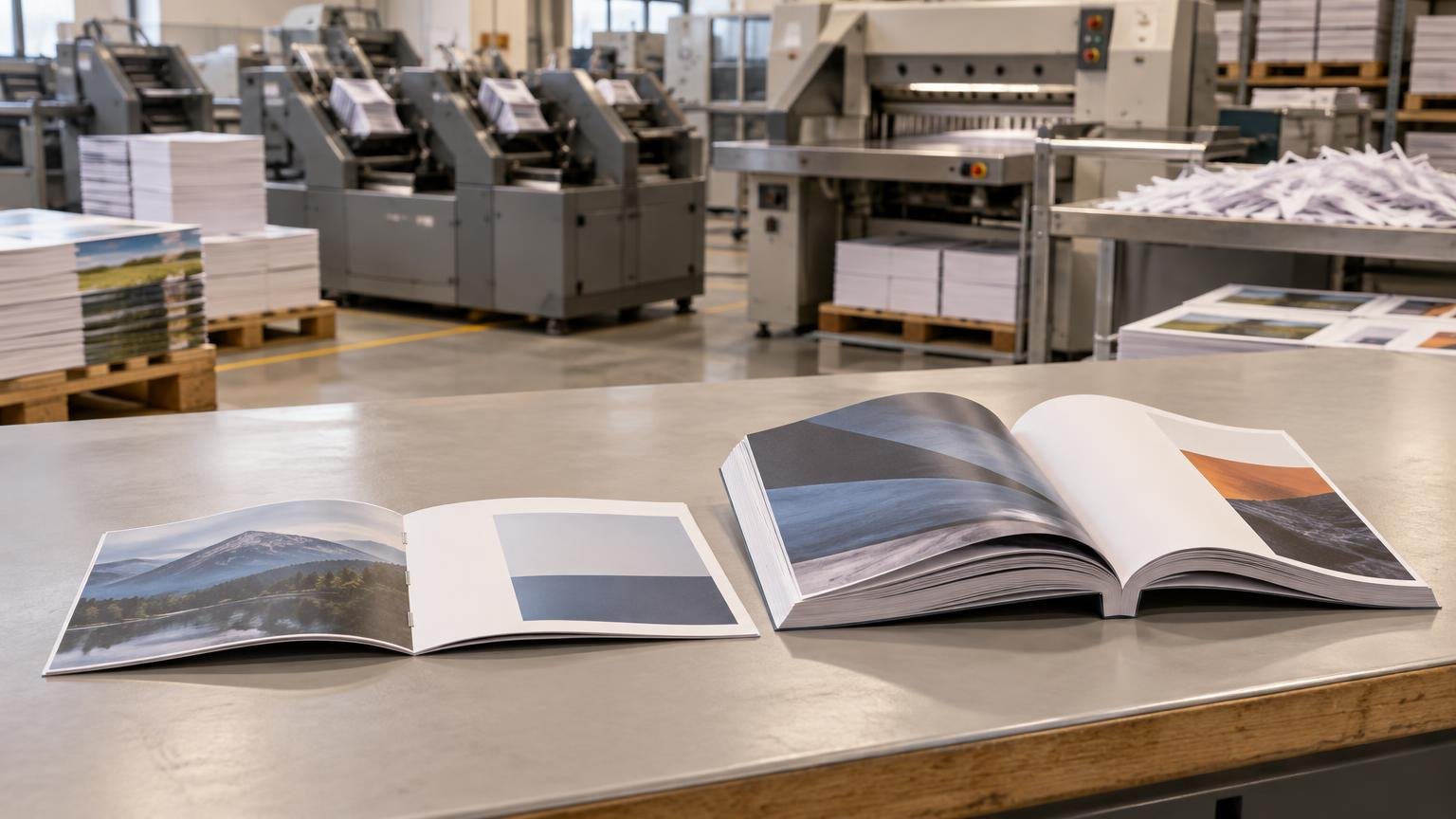
The construction difference is straightforward. Saddle-stitched booklets consist of folded sheets nested together and secured through the fold with wire stitches. Perfect-bound products use adhesive to join a prepared book block to a wraparound cover, producing a square spine. That difference changes how the piece opens, how pages are planned, how artwork is prepared, and how the job moves through finishing.
Perfect binding vs saddle stitch at a glance
| Decision factor | Saddle stitch | Perfect binding |
|---|---|---|
| Construction | Nested folded sheets secured through the center fold | Prepared book block attached to a wraparound cover with adhesive |
| Spine | Folded edge without a square printable spine | Square spine when the finished book is thick enough |
| Opening behavior | Usually opens relatively flat through the center | Has more resistance near the bound edge |
| Thickness concern | Creep and trimming become more significant as the nested stack grows | Minimum and maximum bindable thickness depend on the binding system |
| Page planning | Normally planned in four-page increments | Can offer more page-count flexibility, subject to imposition and equipment |
| Typical fit | Programs, manuals, newsletters, slim catalogs and promotional booklets | Catalogs, magazines, reports and shelf-oriented publications |
| Quote basis | Stock, caliper, page count, trim, quantity and stitcher limits | Stock, book-block thickness, cover, spine width, adhesive system and binder limits |
These are decision tendencies rather than universal operating limits. Finishing manufacturers treat saddle stitching and perfect binding as distinct production systems, but the specifications and cycle rates of an individual machine do not establish that one method is always cheaper or faster across all print shops.
How saddle stitching works
A saddle-stitched booklet begins with printed sheets that are folded, gathered inside one another, and placed over a saddle-shaped support. Wire is driven through the center fold and formed into stitches. The assembled booklet is then trimmed so the open edges are clean and even.
Because each folded sheet creates four numbered pages, conventional saddle-stitched files are normally planned in four-page increments. A 20-page booklet, for example, contains five folded sheets when the cover is included in the same page count and construction. Separate covers, foldouts, inserts, and unusual impositions can change how production describes the job, so the quote should state whether the cover is included in the total page count.
Saddle stitching has no square spine. The bound edge is a fold, which means there is generally no practical spine panel for a title, issue date, or catalog number. Its advantage is opening behavior: a properly made booklet can open broadly without forcing the reader to hold a rigid adhesive-bound spine apart.
Creep is the limiting issue buyers often miss
Nested sheets do not sit in exactly the same horizontal position. As more folded leaves are inserted, the inner leaves are pushed farther outward than the outer leaves. This effect is called creep or push-out. Trimming makes the fore edge even, but it also removes progressively more material from the inner pages. The amount of creep depends on both the number of leaves and the paper’s caliper.
Creep matters to artwork because page numbers, borders, crossover images, and text placed close to the trim can appear inconsistent if the imposition workflow does not compensate for it. It also matters physically: a bulky nested stack may resist closing, produce a rounded fore edge before trimming, or put too much stress on the fold and stitches.
How perfect binding works
Perfect binding begins with a collated book block rather than a set of nested folded sheets. The spine edge is prepared so adhesive can join the pages to a scored, wraparound cover. After binding, the product is commonly trimmed on three sides to create clean head, foot, and fore edges.
The result resembles a paperback book. A sufficiently thick book block creates a square spine that can carry text or graphics. Whether spine text is practical depends on the calculated spine width, production tolerance, and the printer’s artwork requirements. Very narrow spines may technically accept ink but still be poor candidates for readable, well-centered type.
Perfect binding should not automatically be described as more durable. Performance depends on the paper, grain direction, spine preparation, adhesive system, page loading, storage conditions, and intended use. A frequently handled instruction manual and a shelf catalog place different demands on the binding. Ask the printer to recommend the construction for the actual stock and use case rather than relying on the word “perfect.”
Finished thickness matters more than a generic page limit
A universal statement such as “saddle stitch up to 64 pages” is not a dependable buying rule. Sixty-four pages on thin text stock create a different folded package from 64 pages on bulky uncoated paper. A heavy cover can add stiffness even when it contributes little to the page count. Recognized industry guidance likewise notes that the practical saddle-stitch range changes with paper thickness and stock characteristics.
The bindery needs to evaluate the physical package that will enter the machine. Relevant variables include:
- Total page count, with a clear statement about whether the cover is included
- Text and cover stock, including basis weight and caliper
- Finished trim size and binding edge
- Paper grain direction when it affects folding or opening
- Coatings, laminates, folded inserts, gatefolds or tipped-in pieces
- Quantity and the equipment planned for the run
- Required spine width and whether spine text is expected
- Packaging, mailing and final delivery requirements
For a borderline saddle-stitched project, ask for a folded paper dummy made from the intended stocks. It reveals bulk, creep, closing behavior, image loss near the fold, and the overall feel more clearly than a page-count rule can. The bindery’s confirmed machine limits should make the final decision.
Choose by use case, not by appearance alone
Slim event program
A short event program, service booklet, or conference schedule is often a natural saddle-stitch candidate. It benefits from easy opening, has little need for spine text, and can usually be planned cleanly in four-page increments. The buyer should still check whether a heavy cover or bulky uncoated text stock pushes the piece beyond the stitcher’s comfortable range.
Bulky product catalog
A catalog with many products, substantial specifications, and a heavy cover may fit perfect binding better. The square spine improves shelf identification and avoids forcing a large number of sheets into one nested section. However, images and text should not be placed too close to the bound edge because the pages will not open like a center-folded booklet.
Shelf-facing magazine or report
When readers will store the publication on a shelf, a usable spine can carry the title, volume, month, or report name. That presentation advantage may justify perfect binding even when another construction is technically possible. Confirm the spine width before designing it; do not estimate the width from page count without the actual paper caliper.
Direct-mail booklet
Either construction may be relevant to a mailed piece, but binding is only one part of postal design. USPS defines a booklet as a mailpiece with a bound edge or spine and recognizes saddle stitching, perfect binding, pressed-glued construction, and other methods that attach pages to a spine. Eligibility also depends on the complete construction and applicable mailpiece standards, not merely the binding name.
Have the finished dimensions, weight, orientation, tabbing or closure plan, address area, paper, and binding reviewed before production. The current USPS commercial mail design standards are the appropriate starting point, but a mail service provider should review the exact piece and intended mail class. Bound Printed Matter is a specific USPS category with its own eligibility requirements; it is not a generic label for every mailed booklet.
If a booklet supports a broader campaign, align its format and production plan with the direct-mail strategy before approving artwork. A design that looks good by itself can still create trouble when addressing, postal preparation, packaging, and delivery timing are added.
Which method costs less or runs faster?
Neither binding method is universally cheaper or faster. Saddle stitching can be an efficient workflow for an appropriate slim booklet, while perfect binding adds book-block preparation and adhesive binding. Yet the final result depends on quantity, press format, imposition, stock availability, cover treatment, bindery setup, waste, scheduling, packing, and freight.
Compare quotes only after normalizing the specifications. A saddle-stitched quote on self-cover stock is not equivalent to a perfect-bound quote with a heavier laminated cover. Likewise, one quote may include file review, proofs, cartons, freight, or mailing preparation that another excludes. The broader print estimating process shows why materials, setup, waste, finishing, and freight all belong in the delivered-cost comparison.
Production route can matter as much as binding. Run length, sheet size, color requirements, and personalization may change whether the pages are printed digitally or by offset before entering the bindery. Buyers weighing that upstream decision can review offset versus digital printing separately rather than assuming the binding method dictates the press.
Artwork differences to resolve before design approval
For saddle stitching, establish the final page count early, allow the printer to handle imposition, and keep critical elements away from trim and fold risk areas. Do not submit reader spreads unless the printer specifically requests them. Individual pages are usually the safer production-file structure.
For perfect binding, obtain the printer’s cover template after the text stock and page count are final. The outside cover typically needs a continuous layout containing the back cover, spine, and front cover, with the precise panel widths, scores, bleed, and safe areas defined by the printer. Changes to stock or page count can change spine width and invalidate an earlier template.
In both cases, check bleed, image resolution, color setup, fonts, overprint behavior, and safe margins. The print-ready file setup guide covers the broader prepress checks that should happen before files reach the bindery.
What to send when requesting a binding quote
A useful quote request gives the estimator enough information to plan the press sheet, binding route, labor, waste, packaging, and schedule. Provide:
- Finished trim size and binding orientation
- Total pages, stating whether that number includes the cover
- Text stock and cover stock, or the desired feel if stocks are undecided
- Color specification for text and cover
- Quantity, plus any useful quantity alternatives
- Coating, lamination or other cover treatment
- Foldouts, inserts, perforations, pockets or unusual components
- Mailing, addressing, fulfillment or kitting requirements
- Delivery ZIP code and whether freight must be included
- Required in-hands date rather than only a hoped-for production time
- A request for a physical dummy when the saddle-stitch thickness is borderline
If the project is ready for supplier discussions, a commercial printing provider such as Printiverse can be considered alongside other qualified bidders. Give every bidder the same specifications so the comparison reflects production capability and delivered cost rather than differences in assumptions.
Common questions
Is there a universal saddle-stitch page limit?
No dependable universal limit applies to every job. Practical capacity changes with paper caliper, cover stiffness, trim size, inserts, and the specific stitcher. Treat published page counts as equipment- and stock-dependent guidelines.
Can a saddle-stitched booklet have spine text?
Not in the conventional square-spine sense. Its bound edge is a folded curve rather than a flat panel, so spine text is generally impractical.
Can a perfect-bound book have spine text?
Yes, when the finished spine is wide enough to reproduce and center the text within the printer’s tolerances. Request the final cover template before building the spine artwork.
Which binding opens flatter?
Conventional saddle stitching usually opens more freely because pages pivot at the center fold. Standard perfect binding tends to resist opening near the adhesive-bound edge. Specialized lay-flat constructions are separate options and should not be assumed from a basic perfect-binding quote.
Is saddle stitching always cheaper or faster?
No. It may be economical for a suitable slim booklet, but quantity, press imposition, stock, setup, finishing equipment, schedule, and outside bindery requirements determine the actual price and turnaround.
Make the binding decision from the physical job
Use saddle stitching for a relatively slim, fold-centered booklet when easy opening matters and a square spine does not. Use perfect binding when the finished thickness supports an adhesive-bound book block and the project benefits from paperback-style presentation or shelf identification.
Before committing, finalize the stock, page count, trim size, cover treatment, quantity, mailing plan, and delivery date. Then ask the printer to calculate finished thickness and confirm the job against its equipment. When the saddle-stitch choice is close, a physical dummy is the most useful next step: it turns an abstract page count into the booklet you are actually buying.
References
- Horizon | Topics
- Book Printing: Selected Binding Options, Tips, and Tricks
- Web Press, Perfecting Presses, Saddle-Stitch vs. Perfect Binding, Lay-Flat-Laminate, Print Register, Print Registration
- 200 Commercial Letters, Flats, and Parcels Design Standards | Postal Explorer
- 260 Commercial Mail Bound Printed Matter | Postal Explorer