Handling Damaged or Incorrect Print Shipments in a Fulfillment Program
TLDR
If a printed order arrives damaged or incorrect, keep the product, shipping container, internal packing, and shipping label. Photograph the package and product, record the order and tracking numbers, count the affected pieces, and contact the seller or fulfillment provider before returning or discarding anything. The available remedy depends on the seller’s policy and whether the evidence points to transit damage, a production defect, a fulfillment error, or a correctly produced job that does not meet the customer’s expectations.
For teams searching for a fulfillment returns damaged print procedure, the safest workflow is simple: preserve evidence, classify the problem, report it through the correct channel, and wait for instructions. Do not promise a refund, reprint, or carrier claim until the order facts and applicable policies have been reviewed.
What to do immediately after delivery
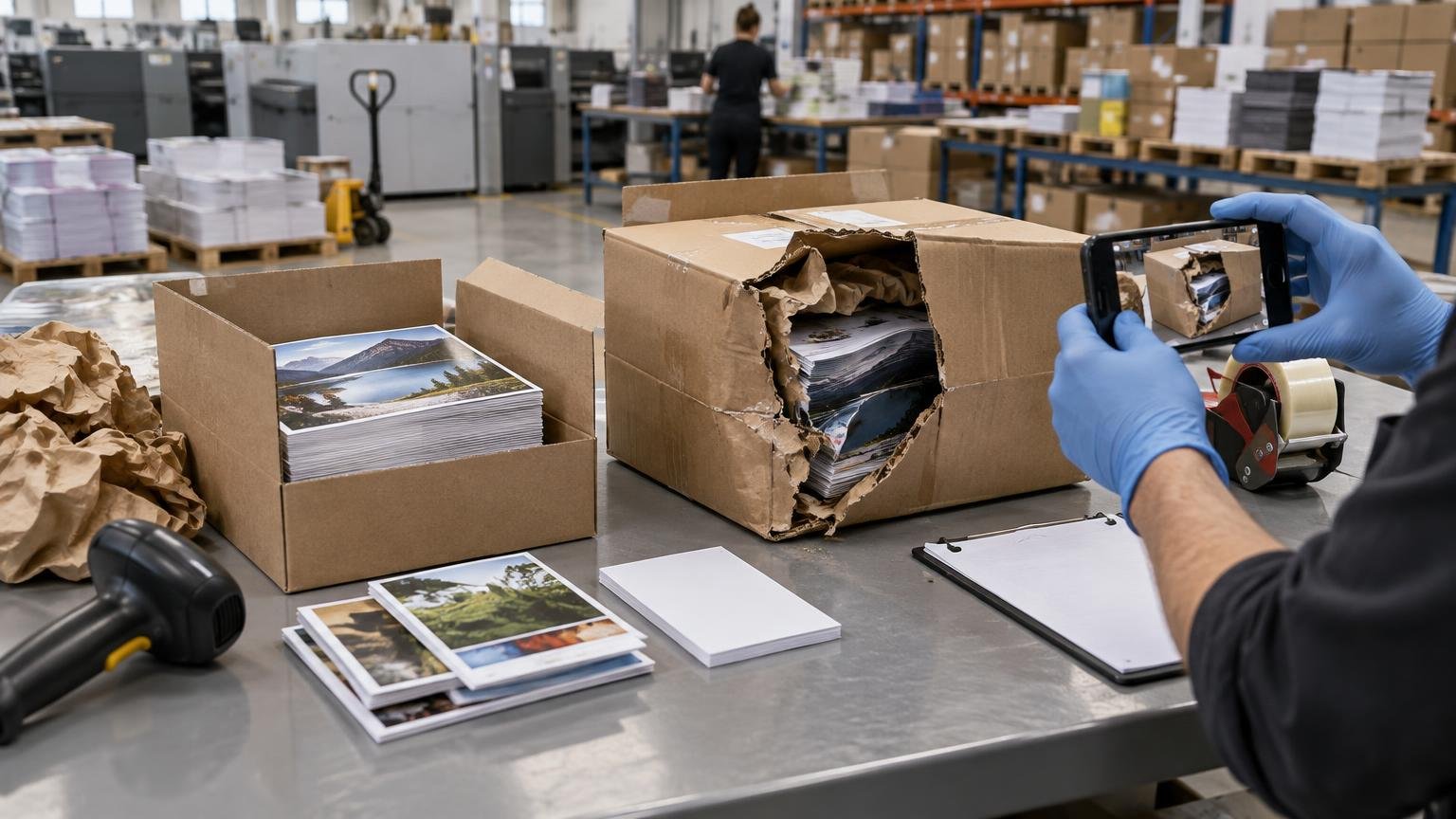
Start by preventing the loss of evidence. Keep the printed item, box, tube, mailer, pallet wrap, corner protectors, cushioning, inserts, and shipping label together. USPS and FedEx both identify damaged contents, packaging, and supporting documentation as relevant to damage claims. Photos of the item and packaging can help establish what happened during shipment. FedEx also identifies proof of value as potentially relevant documentation.
The recipient should take wide photographs showing the entire shipment before moving to close-ups. Capture every visibly damaged side of the outer package, the shipping label, the way the product was packed, and the damage to the finished print. Photograph undamaged areas when they help show orientation or scale.
Collect the following information in the same report:
- Order or purchase-order number
- Carrier and tracking number
- Delivery date
- Product description, dimensions, material, and finish
- Total quantity received and quantity affected
- A short description of the problem
- Photos of the exterior package, interior protection, shipping label, and product
- Order confirmation, invoice, or other proof of value when requested
- Whether the shipment was accepted, refused, or marked as damaged at delivery
A useful description is specific and observable. “The 24-inch poster tube has a crushed end, and three of the five posters have diagonal creases extending approximately six inches into the image area” is more actionable than “posters arrived bad.” The first version helps an operator assess packaging, quantity, severity, and likely cause without guessing.
Do not throw away the box or mail the product back immediately. The seller, fulfillment provider, or carrier may need photographs, inspection, or the original materials. The USPS claims guidance is one example of why preserving the shipment matters, but the applicable procedure depends on the carrier, service, shipment, and jurisdiction.
Classify the damaged or incorrect print shipment
Classification guides the investigation and likely resolution, but it does not guarantee an outcome. Most complaints fall into one of four categories: transit damage, production defects, fulfillment errors, or non-defect concerns.
| Issue type | Typical evidence | Likely review path |
|---|---|---|
| Transit damage | Crushed tube, punctured mailer, wet carton, bent corners, broken rigid panel, or damage aligning with package impact | Packaging review and possible carrier claim |
| Production defect | Banding, unintended marks, cutting error, missing lamination, incorrect finishing, or print inconsistent with the approved job specification | Production records, proof, samples, and quality inspection |
| Fulfillment error | Wrong artwork, wrong product, mixed quantities, incorrect address label, or missing item | Pick, pack, scan, inventory, and order-record review |
| Non-defect concern | Customer selected the wrong size, supplied incorrect artwork, changed requirements after approval, or expected screen color to match print exactly | Seller return rules, proof history, and order specifications |
Transit damage
Transit damage normally leaves physical clues. A crushed tube can create matching edge damage or creases in a rolled poster. A puncture through a carton may align with a scratch in a laminated sign. Water staining on a mailer may correspond with wrinkling, ink disturbance, or adhesive failure inside.
Packaging is part of the evidence because the investigation is not limited to whether the product is damaged. It also asks how the product was protected and whether the damage pattern is consistent with an external shipping event. That distinction matters when a merchant decides whether to open a carrier claim, replace the order directly, or review its packing method.
Production defects
A production complaint concerns how the job was printed, cut, folded, bound, coated, laminated, or otherwise finished. Examples include shifted cutting that violates the approved layout, missing print on part of a sheet, repeated scratches beneath a laminate, or the wrong finishing operation.
Review the complaint against the accepted artwork, proof, written specification, and inspection criteria. ISO 12647-1 addresses parameters and measurement methods for process control involving halftone color separations, proofs, and production prints. It supports the broader principle that color and print-quality disputes are easier to assess when the job has documented production targets and measurement conditions. ISO’s overview of ISO 12647-1
A proof is not a substitute for every production check, but it establishes what content, placement, version, and sometimes color appearance were approved. Strong incoming files also reduce ambiguity. The guide to setting up print-ready artwork explains how bleed, safe areas, image quality, and file preparation affect the finished job.
Fulfillment errors
A fulfillment error occurs after or around production rather than within the printing process itself. The product may be printed correctly but packed into the wrong order, assigned the wrong shipping label, shipped in the wrong quantity, or combined with an incorrect insert.
These cases should be checked against order data, product identifiers, pick records, packing scans, carton labels, and any station photographs available. A picture of the wrong sticker design next to the shipping label can be more useful than a close-up of the sticker alone because it connects the item to a specific shipment.
Color, file, size, and expectation concerns
Not every dissatisfaction is evidence of damage or defective production. A phone or monitor emits light, while print is viewed through light reflected from ink or toner and the substrate. Screen brightness, display calibration, paper color, ink set, coating, and viewing conditions can all affect appearance. The practical issue is whether the delivered job meets the approved proof and agreed production specification, not whether it exactly matches an uncontrolled display.
For jobs where color is critical, document the intended color values, output process, substrate, proof type, and acceptance method before production. The discussion of choosing sticker colors that print accurately provides a useful preparation workflow for avoiding screen-to-print surprises.
The same logic applies when a customer chooses the wrong dimensions or submits outdated artwork. If the seller produced the approved specification correctly, the request may be handled under a non-defect return or reorder policy rather than as a damaged-product claim. Custom and made-to-order products often require a policy-specific review, so neither the merchant nor the customer should assume automatic eligibility.
A fulfillment returns damaged print decision workflow
Use a consistent workflow so customer service, production, and fulfillment teams do not make conflicting promises.
- Acknowledge the report and tell the recipient to retain the product and all packaging.
- Confirm the order number, tracking number, delivery date, product specification, and affected quantity.
- Request clear photographs that connect the product, packaging, and shipping label to the complaint.
- Classify the issue provisionally as transit damage, production defect, fulfillment error, or non-defect concern.
- Compare the complaint with the approved artwork, proof, order specification, production record, and packing record.
- Check the seller’s current policy and any applicable carrier instructions before authorizing a return or disposal.
- Communicate the approved outcome, responsible party, return instructions, and expected next action in writing.
- Record a cause code and feed recurring problems into production, packaging, or fulfillment corrective action.
Return rules are set at the store or seller level rather than by one universal ecommerce standard. Shopify, for example, documents store-level return rules and distinguishes rules for fulfilled items from cancellation rules for unfulfilled items. One fulfillment provider, Printful, states that qualifying damaged, defective, or misprinted products may be eligible for a replacement or refund and requests a clear photograph, but that is an example of its own policy—not an industry-wide guarantee.
When evaluating outsourced printing and production options, merchants should compare the damaged-order workflow as carefully as price and turnaround. Ask who receives customer evidence, who decides whether the issue is production or transit related, who files any carrier claim, and how replacements enter the production queue.
Possible resolutions and what each requires
A documented complaint may lead to a reprint and reshipment, refund, authorized return, carrier claim, partial resolution for the affected quantity, or another response allowed by the seller’s policy. The correct path depends on the facts, commercial agreement, customization status, and available evidence.
Reprint and reshipment
A reprint is often operationally appropriate when a confirmed production or fulfillment error makes the product unusable and the customer still needs the order. Before releasing it, verify the artwork version, quantity, material, finish, destination, and packaging method. Repeating the original job without addressing the cause can repeat the failure.
Refund or account credit
A refund or credit may be considered when allowed by the seller’s policy, but it should not be promised before review. The decision may differ when only part of a shipment is damaged, the unaffected quantity remains usable, or the job was produced correctly from customer-approved specifications.
Authorized return for inspection
Do not tell the customer to send a damaged print to an arbitrary address. If a return is required, provide written authorization, the correct destination, packing instructions, labeling requirements, and any supplied return label. The sender should retain tracking and proof of drop-off until the case is closed.
Carrier claim
The party responsible for filing a carrier claim varies. USPS states that either the sender or recipient may file an eligible domestic claim, subject to its rules, but that does not establish a universal process for every carrier or seller. A merchant should verify who purchased the shipping service, who holds the necessary proof of value, and what the applicable carrier requires before assigning the task.
What fulfillment teams should record
A closed customer ticket should become operations data. Use consistent cause codes such as crushed package, moisture exposure, surface abrasion, incorrect SKU, wrong artwork version, short count, finishing defect, cutting defect, and customer-specification issue. Record the product format, carrier, service level, package type, production batch, station, and resolution cost where available.
Look for patterns rather than reacting only to individual complaints. Repeated crushed poster tubes may justify stronger end caps or a different tube wall. Scratched laminated signs may point to inadequate interleaving. Mixed sticker versions may reveal weak SKU identification or incomplete scan controls. Recurring corner damage on rigid boards may indicate that the package lacks adequate clearance or edge protection.
Resolution cost should include more than the reprinted sheets. Material, press time, finishing, packing labor, replacement packaging, freight, customer-service time, and schedule disruption all matter. The framework for estimating materials, setup, waste, finishing, and freight can also be applied to the cost of preventable rework.
Quarantine claim-relevant products and packaging when inspection may be required. Keep them separate from ordinary returns so evidence is not discarded, altered, or accidentally returned to inventory. Once the seller or carrier authorizes disposal, record that authorization with the case.
Questions customers and merchants commonly ask
Do I need to return a damaged custom print?
Possibly, but do not return it until the seller provides instructions. Some cases may be resolved with photographs, while others may require inspection or return authorization. The applicable seller policy controls the next step.
What photos should I provide?
Provide the entire product, close-ups of each defect, every damaged side of the package, the internal protection, and a readable shipping label. Add an image showing the affected quantity when practical. The photographs should make it possible to connect the damage to the product and shipment.
What if only the package is damaged?
Inspect the contents carefully and document the package before discarding it. If the printed product is undamaged and complete, the case may not require a product remedy, but recording the packaging failure can still help the merchant identify a recurring risk.
What if I selected the wrong size or supplied the wrong file?
Report the issue honestly and review the proof and order confirmation. If the product matches the approved specification, it is generally a non-defect concern and must be handled under the seller’s rules for custom products, returns, or reorders.
The practical next step
A damaged-print case is easiest to resolve when the evidence remains intact and the report separates observation from assumption. Keep everything, photograph it clearly, identify the affected quantity, and contact the responsible seller or fulfillment provider before taking further action.
For merchants, publish one accessible policy that states the reporting window, required evidence, custom-product eligibility, return-authorization process, carrier-claim responsibility, and available remedies. Then train customer service, production, and fulfillment teams to follow the same decision path. Consistency protects the customer experience while giving operations the information needed to prevent the next damaged shipment.
References
- File a Claim | USPS
- File a Claim | FedEx
- ISO 12647-1:2013 – Graphic technology — Process control for the production of half-tone colour separations, proof and production prints — Part 1: Parameters and measurement methods
- Shopify Help Center | Setting up return and cancellation rules
- What is Printful's return and refund policy? – Printful Help Center