
International Print Fulfillment: Freight, Duties, Packaging, and Timing
International print fulfillment works best when customs, packaging, freight, and recipient data are treated as production specifications—not details to resolve after the job is printed. The practical goal is to define what is crossing the border, who pays each charge, how the packed dimensions affect freight, and how much schedule buffer the campaign can tolerate.
That matters whether the job is a pallet of brochures going to a regional warehouse, individual sales kits shipped to customers, or personalized mail entering several postal systems. Each model creates a different combination of customs entries, parcel charges, address rules, packaging labor, and delivery risk.
TLDR
Build the fulfillment plan before approving print production. Confirm the commodity description and classification, country of origin, declared value, duty-and-tax payer, destination restrictions, packed dimensions, address format, and required delivery date. Then calculate backward through production, finishing, kitting, export preparation, transportation, customs clearance, and last-mile delivery. A cheap freight quote is not useful if the shipment arrives with unpaid charges, damaged corners, invalid addresses, or no time left to recover.
Start by defining the shipment model
Do not quote “international shipping” as if it were one operation. Separate the project into shipment types. Bulk freight to one warehouse may involve pallets, commercial entry, and local distribution. Parcel fulfillment creates one customs record and last-mile event for every order. International direct mail follows postal eligibility, preparation, and destination rules that may differ from ordinary merchandise shipments.
The contents matter as much as the route. A printed catalog sent by itself may be handled differently from a kit containing a catalog, product sample, electronic accessory, or promotional item. USPS distinguishes documents from merchandise, and merchandise requires a declared value and customs documentation; service eligibility also varies by destination.
Create a shipment matrix before estimating. List each destination country, shipment type, contents, quantity, packed weight, packed dimensions, service level, delivery requirement, and intended payer of duties and taxes. This extends the same cost discipline used in commercial print estimating into the cross-border portion of the job.
Customs data must match the physical contents
A commercial invoice normally needs shipper and receiver details, an accurate goods description, value, currency, quantity, weight, country of origin, freight-related costs, reason for export, classification, and the applicable Incoterm. Incomplete descriptions, questionable values, and incorrect classifications are common reasons for customs holds.
Avoid vague descriptions such as “marketing materials,” “samples,” or “printed items” when a more precise description is available. State what the goods actually are, such as bound product catalogs, printed paper labels, or retail presentation kits containing specified components. The description on the invoice should agree with the fulfillment record and the contents of the carton.
For goods entering the United States, U.S. Customs and Border Protection’s invoice guidance calls for an adequate description, quantity, value, and the appropriate eight-digit HTS subheading. CBP also provides binding pre-entry rulings when a business needs greater certainty about classification, origin, marking, or trade-program treatment.
U.S. exporters should also check filing obligations for larger shipments. The Census Bureau says Electronic Export Information through AES is generally required when physical goods exceed $2,500 per Schedule B or commodity classification, and for licensed goods regardless of value. U.S. Census Bureau AES guidance explains the filing framework.
Decide who pays duties and taxes before checkout
The buyer experience changes sharply depending on whether import charges are prepaid or collected from the recipient. If the customer expects a fully delivered price but receives a demand for duties, tax, or a carrier fee, the result may be a refused parcel and an expensive return.
Incoterms allocate responsibility for carriage, risk, costs, insurance, and import or export formalities, but they do not replace the sales contract. Under DDP, the seller takes the greatest responsibility, including duties, taxes, and import formalities. International Chamber of Commerce guidance on Incoterms provides the formal framework.
Whichever model is chosen, align the quotation, customer messaging, order system, carrier account, commercial invoice, and returns policy. Some standard international parcel services are structured with duties and taxes unpaid, so the carrier setup cannot be left to contradict the promise made at checkout. Tax and low-value import rules also change, making destination-specific verification necessary when the program launches and whenever its shipping configuration is reviewed.
Engineer packaging around damage and dimensional weight
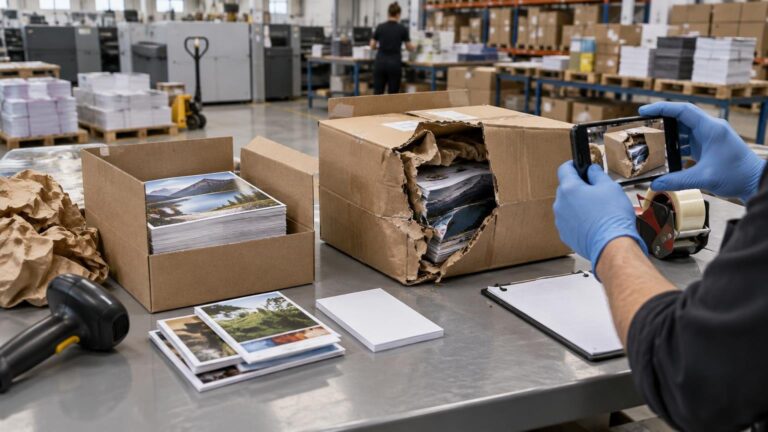
Printed products are often relatively light but vulnerable to bent corners, abrasion, moisture, telescoping stacks, and crushed edges. A rigid mailer may protect a booklet better than a flexible envelope, but added dimensions can increase the freight charge. Presentation boxes and loosely packed kits can create the same problem at a larger scale.
DHL Express states in its 2026 U.S. rate guide that it charges by volumetric weight when that exceeds actual weight, using length × width × height in inches divided by 139 for each piece. The operational lesson applies beyond one carrier: estimate from the finished, packed carton—not from the bare printed product.
- Use right-sized cartons or mailers that restrain the contents without leaving large voids.
- Protect corners, edges, foil surfaces, laminates, and other finishes likely to scuff or crack.
- Test the complete kit, including inserts and merchandise, rather than testing the printed component alone.
- Record packed dimensions and weight after the packaging design is approved.
- Define carton labels, document pouches, pallet patterns, and any destination-specific markings before release.
Document the packaging standard with photographs and pack-out instructions. If damage occurs, a consistent record makes it easier to separate a production defect from packing failure or transit damage. The workflow in handling damaged or incorrect print shipments can be adapted for international claims and replacement decisions.
Treat address validation as an upstream production step
An address that fits a domestic database template may not be complete or correctly arranged for another country. The Universal Postal Union’s S42 standard defines common address elements and country-specific templates, while destination postal rules can add their own conditions. Universal Postal Union addressing resources are a useful reference when building international data fields.
Collect country, postal code, locality, administrative area, street lines, recipient name, and phone or email where the selected carrier requires them. Preserve non-English characters where systems support them, and test label output before processing the full file. For personalized campaigns, apply these checks alongside the data controls used in variable-data direct mail planning.
Build timing from the delivery date backward
International timing is a chain, not a single carrier estimate. Allow for file approval, printing, drying or curing where applicable, finishing, quality control, kitting, packaging, export documentation, carrier collection, linehaul, customs clearance, last-mile delivery, and exception handling.
| Stage | Decision to lock | Typical failure to prevent |
|---|---|---|
| Production | Final quantity, versions, substrate, finish, and proof approval | Late artwork changes consuming the shipping buffer |
| Pack-out | Kit contents, carton size, labels, and quality checks | Missing components or unexpected dimensional weight |
| Customs | Description, classification, value, origin, and payer | Clearance hold or recipient charge dispute |
| Transportation | Service level, cutoff, tracking, and handoff points | A quote based only on linehaul time |
| Delivery | Validated address and local contact data | Undeliverable parcel or delayed campaign launch |
For date-critical launches, split the risk where the economics justify it. A small advance shipment can support sales teams or launch events while the main quantity moves through a slower channel. Keep replacement stock at a location that can serve the affected region without repeating the longest international leg.
The practical buying checklist
Before authorizing an international fulfillment program, ask the printer or fulfillment provider for the packed specification, not just the printed-piece specification. Confirm carton dimensions, gross weight, packing labor, carrier service, customs-data workflow, tracking events, duty treatment, address validation, returns handling, and the process for damaged or refused shipments.
The strongest plan makes landed cost and delivery responsibility visible before production starts. Define the goods accurately, choose the duty payer deliberately, minimize packaging volume without sacrificing protection, validate destination data, and leave time for customs exceptions. That turns international print fulfillment from an improvised shipping task into a controlled production workflow.
References
- 123 Customs Forms and Online Shipping Labels | Postal Explorer
- Mailing Standards of the United States Postal Service – International Mail Manual – April 6, 2026
- What Documents Do I Need for Shipping? – DHL Express – United States of America
- Commercial invoice requirements when clearing or filing entry documents with U.S. Customs and Border Protection
- Binding Ruling Program
- FTD – AES – Document Library
- ICC Digital Library
- International Shipping Service – DHL eCommerce – United States of America
- DHL Express Service & Rate Guide 2026
- Addressing Solutions